Can AI Really Manage Your Money? The Rise of AI-Powered Personal Finance Apps in 2026
Discover how AI-powered personal finance apps help with budgeting, saving, investing, and financial planning in 2026. Learn the benefits, risks, and whether AI can truly manage your money.
FINANCE
cryptofinora Team
7/15/20266 min read
Can AI Really Manage Your Money? The Rise of AI-Powered Personal Finance Apps in 2026
Managing money has never been easy. From creating a monthly budget to tracking expenses, paying bills on time, and planning investments, personal finance requires discipline and informed decision-making. In 2026, however, artificial intelligence (AI) is changing the way people manage their finances. AI-powered personal finance apps are becoming smarter, faster, and more personalized than ever before.
Millions of people across the United States, the United Kingdom, Canada, and other countries now rely on AI to analyze spending habits, recommend savings strategies, monitor investments, and even predict future financial challenges. Instead of manually reviewing bank statements or maintaining spreadsheets, users receive real-time insights that help them make better financial decisions.
But an important question remains: Can AI really manage your money, or should it only be used as a financial assistant? This guide explores how AI personal finance apps work, their advantages, limitations, and what the future holds for AI-driven money management.
What Are AI Personal Finance Apps?
AI personal finance apps are digital tools that use artificial intelligence and machine learning to help users organize, monitor, and improve their financial lives.
Unlike traditional budgeting apps that only record transactions, AI-powered platforms analyze your financial behavior and provide personalized recommendations. They can identify spending patterns, detect unusual activity, suggest ways to save money, and even estimate future expenses based on your financial history.
Many modern finance apps also integrate with bank accounts, credit cards, investment portfolios, and digital wallets, giving users a complete view of their financial situation from a single dashboard.
How AI Helps You Manage Your Money
Artificial intelligence performs several important tasks that simplify financial management.
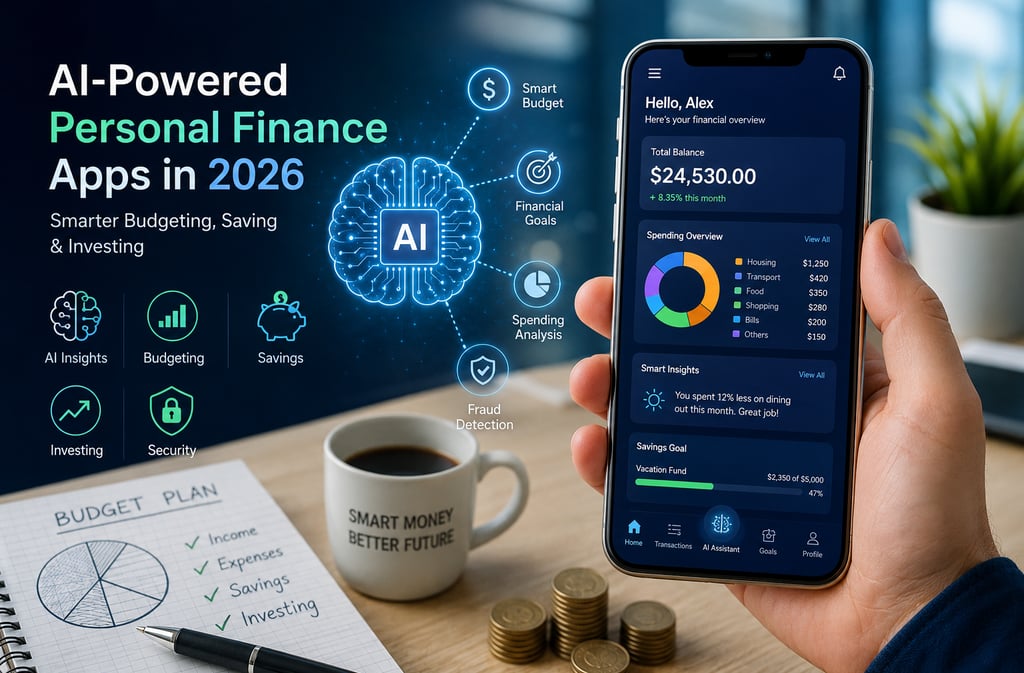
Smart Budgeting
AI automatically categorizes your income and expenses, making it easy to understand where your money is going each month. Instead of manually sorting transactions, the app identifies spending on groceries, transportation, entertainment, healthcare, subscriptions, and other categories.
If your spending exceeds your budget, the app can immediately notify you and suggest ways to reduce unnecessary expenses.
Personalized Savings Recommendations
One of AI's greatest strengths is identifying opportunities to save money.
For example, AI can recognize recurring subscriptions that you rarely use or highlight monthly expenses that have gradually increased over time. Some apps even recommend transferring small amounts into savings whenever they detect extra cash in your account.
This automated approach helps users build savings without dramatically changing their lifestyle.
Investment Guidance
AI-powered investment platforms, often called robo-advisors, analyze your financial goals, risk tolerance, and investment timeline before suggesting diversified portfolios.
These platforms continuously monitor market conditions and automatically rebalance investments when necessary. While they cannot predict the future, they help investors maintain long-term strategies based on data rather than emotion.
Bill Payment Reminders
Late payments can damage credit scores and result in unnecessary fees.
AI finance apps track upcoming bills and send reminders before payment deadlines. Some platforms even estimate future cash flow to ensure you have enough money available when bills become due.
Fraud Detection
Artificial intelligence can identify suspicious account activity much faster than manual monitoring.
If an unusual transaction occurs, AI systems compare it with your normal spending habits and alert you immediately. This allows users to respond quickly to potential fraud or unauthorized purchases.
Financial Goal Tracking
Whether you're saving for a vacation, buying a home, paying off debt, or building an emergency fund, AI helps monitor your progress toward financial goals.
The software adjusts recommendations as your income or spending habits change, making financial planning more flexible and realistic.
Benefits of AI Personal Finance Apps
AI-powered personal finance apps are changing the way people manage their money. They don't just track spending—they provide personalized insights that help users make smarter financial decisions.
1. Saves Time
Instead of manually recording every transaction, AI automatically categorizes your income and expenses. This reduces paperwork and gives you a clear overview of your finances in seconds.
2. Better Budgeting
AI analyzes your spending habits and creates realistic budgets based on your lifestyle. It can also notify you before you exceed your monthly spending limit.
3. Smarter Saving
Many AI finance apps identify small opportunities to save money. They may recommend cutting unnecessary subscriptions, reducing overspending, or automatically transferring spare cash into a savings account.
4. Personalized Financial Advice
Unlike generic budgeting tools, AI learns from your financial behavior and offers recommendations tailored to your goals, whether you're saving for a home, paying off debt, or investing for retirement.
5. Investment Support
AI-powered investment platforms help users build diversified portfolios based on their financial goals and risk tolerance. They can also monitor portfolios and suggest adjustments when market conditions change.
6. Improved Financial Awareness
Real-time reports and spending insights help users understand where their money goes every month, making it easier to develop healthier financial habits.
Limitations of AI Money Management
Although AI offers many advantages, it is not perfect.
Limited Human Judgment
AI makes decisions based on historical data and algorithms. It cannot fully understand personal situations such as family emergencies, career changes, or emotional factors that often influence financial decisions.
Data Privacy Concerns
Finance apps usually require access to sensitive banking information. Users should choose trusted providers with strong encryption, multi-factor authentication, and transparent privacy policies.
Market Uncertainty
No AI system can accurately predict stock market movements or cryptocurrency prices every time. Investing always involves risk, regardless of the technology being used.
Overdependence
Relying entirely on AI without understanding basic financial principles may lead to poor long-term decision-making. AI should support your financial planning—not replace your own judgment.
Can AI Replace Financial Advisors?
For many people, AI can handle everyday financial tasks such as budgeting, expense tracking, savings planning, and basic investment recommendations.
However, complex financial situations—including estate planning, tax strategies, business investments, or retirement planning—often benefit from advice provided by qualified financial professionals.
The future is likely to combine AI-powered tools with human expertise, giving users the advantages of both speed and personalized guidance.
Best Features to Look for in an AI Finance App
Before choosing an AI-powered finance app, consider these features:
Secure bank account integration
Automatic expense categorization
Personalized budgeting tools
Investment tracking
Bill payment reminders
Savings automation
Debt management assistance
Credit score monitoring
Strong security and encryption
Multi-device support
Choosing an app with these capabilities can make managing your finances simpler and more effective.
AI and the Future of Personal Finance
Artificial intelligence is expected to play an even larger role in financial management over the coming years.
Future AI finance apps may provide:
More accurate cash-flow forecasting
Voice-controlled financial assistants
Advanced retirement planning tools
Personalized tax-saving suggestions
Smarter fraud detection
Better investment portfolio optimization
Integration with digital wallets and central bank digital currencies (CBDCs)
As AI technology continues to improve, financial management is becoming more accessible, data-driven, and personalized for people around the world.
Frequently Asked Questions (FAQs)
Are AI personal finance apps safe to use?
Most reputable AI personal finance apps use bank-level encryption, multi-factor authentication (MFA), and secure cloud infrastructure to protect user data. However, it's important to choose trusted providers and keep your login credentials secure.
Can AI help me save more money?
Yes. AI analyzes your spending habits, identifies unnecessary expenses, recommends realistic budgets, and can even automate small savings transfers. These features make it easier to build healthy financial habits over time.
Can AI manage my investments?
AI can assist with portfolio management, asset allocation, and investment monitoring. However, it cannot guarantee profits or accurately predict market movements. Investment decisions should always align with your financial goals and risk tolerance.
Are AI finance apps free?
Many apps offer free basic features such as budgeting and expense tracking. Advanced tools like investment management, financial coaching, and premium analytics often require a paid subscription.
Should beginners use AI finance apps?
Absolutely. Beginners can benefit from AI-powered budgeting, spending insights, savings recommendations, and educational tips that make managing money much easier.
Final Thoughts
Artificial intelligence is transforming personal finance by making budgeting, saving, investing, and financial planning more efficient than ever before. Instead of spending hours organizing transactions or creating spreadsheets, users can receive real-time insights and personalized recommendations within seconds.
While AI offers impressive convenience and automation, it should be viewed as a financial assistant rather than a complete replacement for human judgment. Major life decisions, tax planning, and complex investments still require careful research and, in many cases, professional financial advice.
For most people, the best approach is to combine AI-powered tools with a solid understanding of personal finance. By doing so, you can make smarter decisions, avoid common financial mistakes, and work toward long-term financial stability.
As AI technology continues to evolve, personal finance apps will become even more intelligent, helping millions of people build wealth, reduce financial stress, and achieve their financial goals with greater confidence.
Key Takeaways
AI personal finance apps automate budgeting and expense tracking.
They provide personalized savings and investment recommendations.
AI can detect unusual spending patterns and improve fraud protection.
Robo-advisors help manage investment portfolios efficiently.
AI cannot eliminate investment risk or replace professional financial advice in every situation.
Choosing secure, reputable apps is essential for protecting your financial information.
AI is becoming an important tool for smarter money management in 2026 and beyond.
Conclusion
AI-powered personal finance apps are reshaping how individuals manage their money. From tracking daily expenses to supporting long-term investment planning, artificial intelligence is making financial management simpler, faster, and more personalized.
Whether you're a student learning to budget, a professional aiming to grow your savings, or an investor building long-term wealth, AI can provide valuable insights that improve financial decision-making. However, technology works best when paired with financial knowledge and responsible habits.
The future of personal finance is not about AI replacing humans—it's about AI helping people make better financial decisions every day.
CryptoFinora
Your trusted source for crypto news, blockchain guides, Bitcoin analysis, and personal finance insight.
COMMUNICATION
muneebrehman2224@gmail.com
© 2026 CryptoFinora. All Rights Reserved - Trusted Crypto & Finance Insights.