AI in Personal Insurance 2026 | Smarter Coverage Guide
Discover how AI is transforming personal insurance in 2026 with faster claims, personalized pricing, fraud detection, and smarter customer service.
FINANCE
CryptoFinora Team
7/27/20264 min read
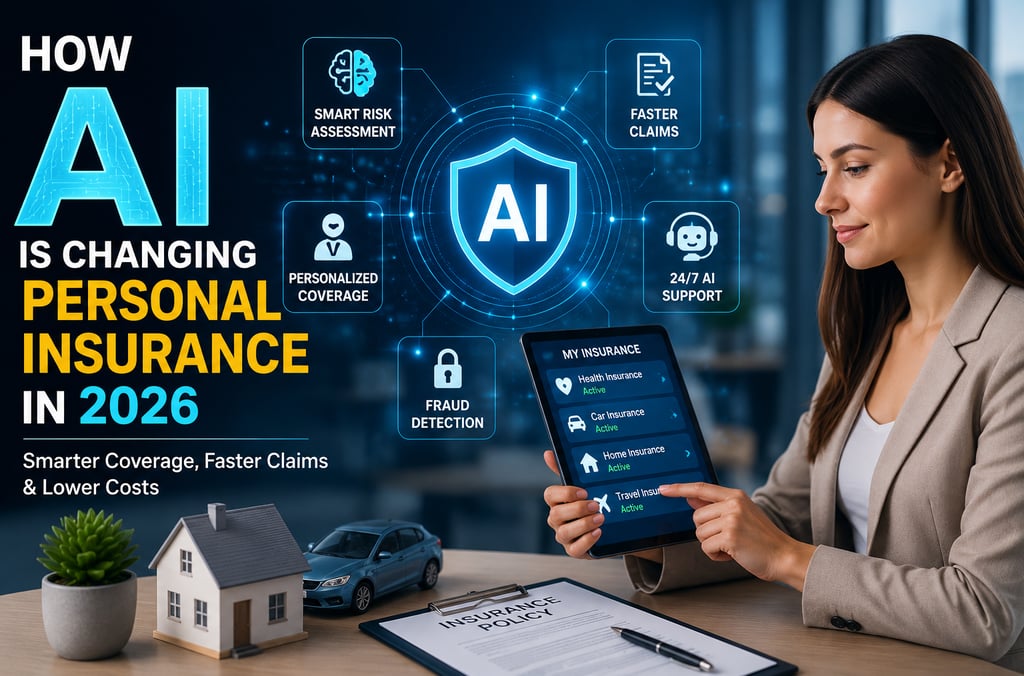
How AI Is Changing Personal Insurance in 2026
Artificial intelligence (AI) is rapidly transforming the insurance industry. What once required days of paperwork, long phone calls, and manual reviews can now be completed in minutes. In 2026, insurance companies are using AI to provide faster claims, personalized policies, smarter fraud detection, and better customer service.
Whether you're looking for health, auto, home, or travel insurance, AI is making coverage more efficient and affordable than ever before. Consumers also benefit from quicker decisions and customized plans that better fit their lifestyles.
Table of Contents
What Is AI in Insurance?
Why Insurance Companies Are Using AI
Faster Claims Processing
Personalized Insurance Pricing
AI and Fraud Detection
Better Customer Support
Benefits for Consumers
Challenges of AI in Insurance
The Future of AI Insurance
Final Thoughts
What Is AI in Insurance?
AI in insurance refers to the use of machine learning, automation, and predictive analytics to improve insurance services. Instead of relying entirely on human agents, insurers analyze large amounts of data to make faster and more accurate decisions.
AI can evaluate risk, estimate claim costs, detect suspicious activity, and recommend policies tailored to individual customers.
Why Insurance Companies Are Using AI
Insurance companies face increasing customer expectations. People want faster claims, lower premiums, and 24/7 support. AI helps insurers achieve these goals by reducing manual work and improving decision-making.
Major insurance providers now use AI to:
Process claims automatically
Detect fraudulent activities
Improve customer support
Predict future risks
Offer personalized insurance plans
Faster Claims Processing
One of AI's biggest advantages is speeding up insurance claims.
Instead of waiting several days for claim approval, AI systems can analyze uploaded documents and photos within minutes. In many simple cases, customers receive approval almost instantly.
For example, after a minor car accident, a customer can upload pictures through a mobile app. AI estimates the damage and begins processing the claim immediately.
This reduces stress while saving insurance companies significant operating costs.
Personalized Insurance Pricing
Traditional insurance often grouped customers into broad categories.
AI changes this by analyzing hundreds of factors, including driving behavior, lifestyle, claim history, and even smart device data (where customers choose to share it).
As a result, safer customers may receive lower premiums while still maintaining strong coverage.
This creates fairer pricing instead of using one-size-fits-all policies.
AI and Fraud Detection
Insurance fraud costs companies billions every year.
AI can quickly identify unusual claim patterns that human reviewers might overlook.
For example, AI systems compare claims against historical data and detect suspicious behavior within seconds.
This helps reduce fraudulent payouts while keeping insurance premiums lower for honest customers.
Better Customer Support with AI
Customer service has become one of the biggest areas where AI is making a difference. Instead of waiting on hold for long periods, policyholders can now get instant answers through AI-powered chatbots and virtual assistants.
These systems are available 24/7 and can help customers:
Check policy details
Track claim status
Update personal information
Receive premium payment reminders
Get instant answers to common questions
For more complex issues, AI transfers the conversation to a human representative along with the customer's history, making the process much faster.
Predicting Risks Before They Happen
Modern AI doesn't just respond to problems—it helps prevent them.
Insurance companies use predictive analytics to estimate future risks based on historical data and current trends.
Examples include:
Predicting areas with higher flood risks
Identifying drivers more likely to have accidents
Detecting health risks from wearable devices (with customer permission)
Forecasting weather-related insurance claims
This allows insurers to prepare in advance and offer advice that helps customers reduce risk.
Benefits of AI for Consumers
AI offers several advantages that improve the overall insurance experience.
Faster Service
Claims that once took days or weeks can often be processed within hours.
Lower Costs
Automation reduces administrative expenses, allowing some insurers to offer more competitive pricing.
Personalized Coverage
Customers receive insurance plans based on their individual needs rather than broad demographic groups.
Improved Accuracy
AI analyzes large datasets, helping reduce human errors during underwriting and claims processing.
Better Security
Advanced fraud detection systems help protect both insurers and honest policyholders.
Challenges of AI in Insurance
Although AI provides many benefits, it also introduces new challenges.
Data Privacy
Insurance companies must handle personal data responsibly and comply with privacy regulations.
Algorithm Bias
If AI is trained on biased data, it may produce unfair pricing or claim decisions. Companies must regularly review and improve their AI models.
Cybersecurity
As insurers rely more on digital systems, protecting sensitive customer information becomes increasingly important.
Human Oversight
AI should assist professionals, not completely replace them. Human experts are still needed for complex claims and sensitive customer situations.
AI Will Continue to Transform Insurance
Experts expect AI to play an even larger role over the coming years.
Future developments may include:
Fully automated claims processing
AI-powered financial advisors for insurance selection
Smarter home and vehicle monitoring
Real-time personalized insurance pricing
More accurate risk prediction using advanced machine learning
Companies that adopt responsible AI are likely to deliver faster, more affordable, and more customer-focused insurance services.
Frequently Asked Questions (FAQs)
1. What is AI in personal insurance?
AI in personal insurance refers to the use of artificial intelligence to automate claims processing, assess risks, detect fraud, and provide personalized insurance recommendations. It helps insurers deliver faster and more accurate services.
2. Can AI approve insurance claims automatically?
Yes. Many insurance companies now use AI to review simple claims automatically. AI analyzes photos, documents, and policy details, allowing straightforward claims to be approved within minutes. Complex cases are still reviewed by human experts.
3. Does AI make insurance cheaper?
AI can help reduce operating costs and improve risk assessment. These savings may allow insurers to offer lower premiums to low-risk customers, although pricing depends on many factors, including coverage type and personal risk profile.
4. Is AI safe for handling personal information?
Most insurance companies use advanced encryption and cybersecurity measures to protect customer data. However, consumers should always choose trusted insurers with strong privacy policies and security practices.
5. Which types of insurance use AI?
AI is widely used in:
Auto insurance
Health insurance
Home insurance
Travel insurance
Life insurance
Business insurance
6. Will AI replace insurance agents?
Not entirely. AI handles routine tasks such as answering questions, processing simple claims, and analyzing data. Human insurance professionals remain essential for complex claims, financial advice, and personalized customer support.
Conclusion
Artificial intelligence is reshaping the insurance industry in 2026 by making services faster, smarter, and more customer-focused. From instant claims processing and personalized pricing to advanced fraud detection and 24/7 customer support, AI is improving nearly every aspect of personal insurance.
While challenges such as data privacy and cybersecurity remain important, responsible AI adoption is creating a more efficient insurance experience for both companies and customers. As technology continues to evolve, AI-powered insurance solutions are expected to become even more accurate, transparent, and accessible worldwide.
Whether you're purchasing your first insurance policy or reviewing your current coverage, understanding how AI works can help you make better financial decisions in the years ahead.
CryptoFinora
Your trusted source for crypto news, blockchain guides, Bitcoin analysis, and personal finance insight.
COMMUNICATION
muneebrehman2224@gmail.com
© 2026 CryptoFinora. All Rights Reserved - Trusted Crypto & Finance Insights.