Dollar-Cost Averaging (DCA): The Beginner's Guide to Smarter Investing in 2026
Learn how Dollar-Cost Averaging (DCA) helps beginners reduce investment risk, manage market volatility, and build long-term wealth in 2026.
INVESTING
CryptoFinora Team
7/11/20267 min read
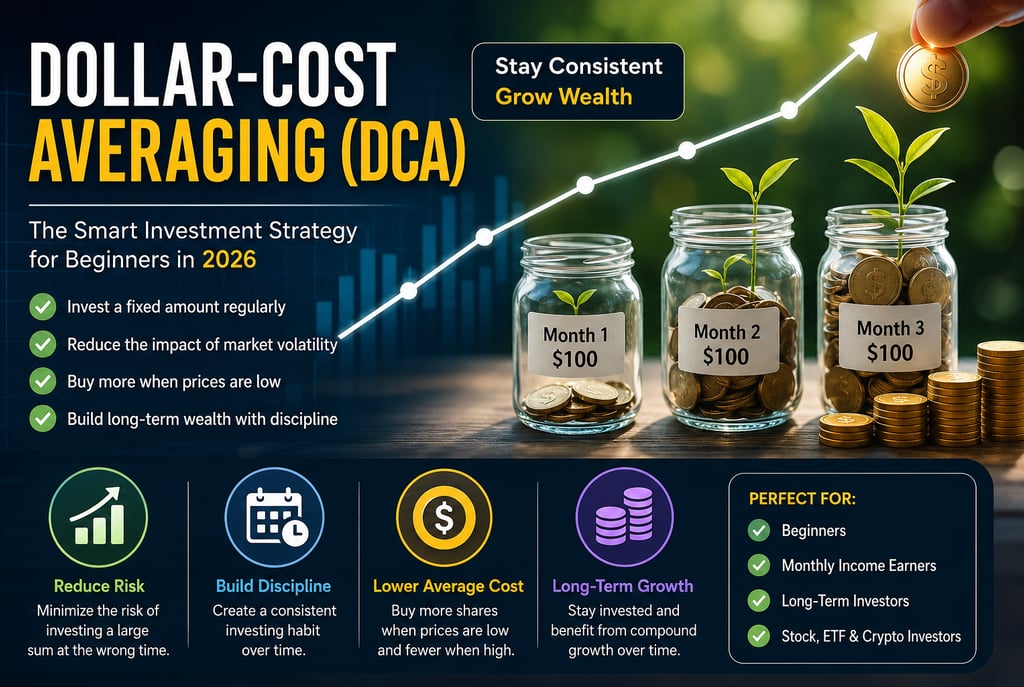
Dollar-Cost Averaging (DCA): The Beginner's Guide to Smarter Investing in 2026
Investing can feel overwhelming, especially when markets are constantly moving up and down. Many beginners worry about buying at the wrong time or losing money because of short-term price swings. Trying to predict the "perfect" moment to invest is difficult, even for experienced investors.
This is where Dollar-Cost Averaging (DCA) becomes one of the most effective long-term investment strategies.
Instead of investing a large amount all at once, DCA allows you to invest a fixed amount of money at regular intervals—whether the market is rising or falling. Over time, this approach can reduce the impact of market volatility and help build wealth with discipline and consistency.
Whether you're investing in stocks, ETFs, index funds, or cryptocurrencies, Dollar-Cost Averaging is a strategy used by millions of investors worldwide.
In this guide, you'll learn what DCA is, how it works, its advantages and disadvantages, and how you can use it to become a smarter investor in 2026.
Table of Contents
What Is Dollar-Cost Averaging?
Why Investors Use DCA
How Dollar-Cost Averaging Works
Real-Life Example
Benefits of DCA
Potential Drawbacks
DCA vs Lump-Sum Investing
Who Should Use DCA?
Common Mistakes to Avoid
Frequently Asked Questions
Final Thoughts
What Is Dollar-Cost Averaging (DCA)?
Dollar-Cost Averaging (DCA) is an investment strategy where you invest the same amount of money on a regular schedule, regardless of whether the market is up or down.
For example, instead of investing $1,200 all at once, you could invest:
$100 every month for 12 months
$25 every week
$500 every quarter
By investing consistently, you buy more shares when prices are low and fewer shares when prices are high. Over time, this can lower your average purchase price.
The goal of DCA is not to beat the market in the short term. Instead, it helps investors stay disciplined, reduce emotional decisions, and focus on long-term growth.
Why Investors Use DCA
Many people hesitate to invest because they fear buying just before the market drops. Others wait too long, hoping prices will fall, and miss opportunities when the market rises.
Dollar-Cost Averaging removes much of this uncertainty.
Instead of trying to predict market movements, you invest according to a schedule. This creates a habit of consistent investing and reduces the stress of market timing.
DCA is especially popular among:
Beginner investors
Long-term retirement savers
ETF and index fund investors
Cryptocurrency investors
People with monthly salaries
How Dollar-Cost Averaging Works
The strategy is simple.
Imagine you decide to invest $200 every month in an index fund.
Month 1
Price per share: $20
You buy 10 shares.
Month 2
Price drops to $16
Your $200 now buys 12.5 shares.
Month 3
Price rises to $25
You purchase 8 shares.
Even though prices changed each month, you continued investing the same amount.
Over time, your average purchase price may become lower than if you had invested everything at a single high price.
This disciplined approach is one of the biggest strengths of Dollar-Cost Averaging.
A Real-Life Example
Let's compare two investors:
Investor A – Lump-Sum Investment
Invests $6,000 in January.
If the market falls significantly after that, the portfolio value may decline in the short term.
Investor B – Dollar-Cost Averaging
Invests $500 every month for one year.
This investor purchases investments at different price levels throughout the year, reducing the impact of short-term market swings.
While neither strategy guarantees higher returns, DCA helps manage risk and encourages long-term investing habits.
Why DCA Works Well During Volatile Markets
Financial markets rarely move in a straight line. Prices can rise quickly, fall sharply, and recover over time.
During these periods, investors who follow a Dollar-Cost Averaging strategy continue investing consistently instead of reacting emotionally.
This approach offers several advantages:
It reduces the temptation to time the market.
It helps investors stay committed during downturns.
It spreads purchases across different market conditions.
It encourages a long-term mindset instead of short-term speculation.
For many investors, consistency is more important than trying to predict every market movement.
Key Benefits of Dollar-Cost Averaging
1. Reduces Emotional Investing
Fear and greed often lead to poor investment decisions. DCA helps remove emotions by following a fixed investment schedule.
2. Builds Investing Discipline
Regular investing creates healthy financial habits and encourages long-term wealth building.
3. Reduces Timing Risk
Since investments are spread over time, the risk of investing all your money at a market peak is reduced.
4. Suitable for Any Budget
You don't need thousands of dollars to start investing. Even small, regular contributions can grow over time through consistency and compounding.
Benefits of Dollar-Cost Averaging
Dollar-Cost Averaging has become one of the most trusted investment strategies because it focuses on consistency rather than trying to predict the market. Below are the key benefits that make DCA popular among both beginner and experienced investors.
1. Reduces Market Timing Risk
One of the biggest challenges in investing is knowing when to buy.
Even professional investors struggle to consistently predict market highs and lows.
With DCA, you don't have to worry about finding the "perfect" entry point. Since you invest at regular intervals, your purchases are spread across different market conditions, reducing the impact of buying at a high price.
2. Encourages Long-Term Investing
Successful investing is usually a marathon, not a sprint.
Dollar-Cost Averaging encourages patience and discipline by focusing on regular contributions rather than short-term market movements.
This long-term mindset helps investors stay committed to their financial goals.
3. Reduces Emotional Decisions
Many investors make mistakes because of emotions.
When markets rise rapidly, some investors buy out of excitement or fear of missing out (FOMO).
When markets fall, others panic and sell at a loss.
DCA helps remove these emotional decisions because investments are made according to a predetermined schedule.
4. Makes Investing More Affordable
You don't need a large amount of money to begin investing.
Instead of waiting until you've saved thousands of dollars, you can start with smaller, regular investments that fit your budget.
This makes investing accessible to students, young professionals, and anyone building wealth gradually.
5. Builds Consistent Financial Habits
Regular investing can become part of your monthly financial routine, just like paying bills or saving money.
Over time, this consistency can have a significant impact on wealth creation.
Potential Drawbacks of Dollar-Cost Averaging
Although DCA has many advantages, it isn't the perfect strategy for every situation.
Understanding its limitations will help you make informed investment decisions.
1. Lower Returns in Strong Bull Markets
If markets continue rising for a long period, investing all your money at the beginning (known as a lump-sum investment) may produce higher returns than spreading investments over time.
However, no one can accurately predict future market performance.
2. Requires Patience
Dollar-Cost Averaging is designed for long-term investing.
Investors looking for quick profits may find the strategy too slow.
Success with DCA comes from consistency over months or years—not days or weeks.
3. Transaction Costs
If your investment platform charges a fee for every purchase, making frequent investments could increase your overall costs.
Many modern brokers and crypto exchanges now offer commission-free investing, making DCA more cost-effective.
Dollar-Cost Averaging vs Lump-Sum Investing
Choosing between Dollar-Cost Averaging and a lump-sum investment depends on your financial situation, risk tolerance, and market outlook.
Feature
Dollar-Cost Averaging
Lump-Sum Investing
Investment Style
Regular fixed investments
One-time large investment
Risk
Lower timing risk
Higher timing risk
Emotional Stress
Lower
Higher
Suitable for Beginners
Yes
Less suitable
Best For
Monthly income earners
Investors with large available capital
Summary:
DCA focuses on reducing risk and building long-term habits.
Lump-sum investing may offer higher returns if markets rise, but it also carries greater timing risk.
Best Investments for Dollar-Cost Averaging
DCA can be used across a variety of investment options.
Stocks
Investing in established companies regularly can help build a diversified portfolio over time.
Index Funds
Index funds are one of the most popular choices for DCA because they provide broad market exposure and lower risk through diversification.
ETFs (Exchange-Traded Funds)
ETFs combine diversification with flexibility, making them ideal for investors using a long-term strategy.
Cryptocurrencies
Many investors use DCA to gradually build positions in well-known cryptocurrencies instead of trying to predict short-term price movements.
Common Dollar-Cost Averaging Mistakes
Avoiding these mistakes can improve your long-term investment results.
Investing Inconsistently
Skipping scheduled investments reduces the effectiveness of the strategy.
Chasing Market Trends
Changing your plan based on headlines or social media can undermine the benefits of DCA.
Ignoring Diversification
Putting all your money into a single investment increases risk. Diversification can help balance your portfolio.
Expecting Immediate Results
DCA is a long-term strategy. Building wealth takes time, patience, and consistent investing.
Tips for Successful Dollar-Cost Averaging
Set a realistic monthly investment budget.
Invest consistently, regardless of market conditions.
Review your portfolio periodically, but avoid making emotional decisions based on short-term price changes.
Diversify across different assets when appropriate.
Focus on long-term financial goals rather than daily market fluctuations.
Who Should Use Dollar-Cost Averaging?
Dollar-Cost Averaging is suitable for many types of investors, especially those focused on long-term financial growth rather than short-term market speculation.
Beginner Investors
If you're new to investing, DCA helps you enter the market gradually without worrying about choosing the "perfect" time to invest.
Monthly Salary Earners
People who receive a monthly income can invest a fixed amount each month, making DCA a practical and sustainable strategy.
Long-Term Investors
Whether you're saving for retirement, a home, or your children's education, DCA supports consistent wealth building over many years.
Crypto Investors
Cryptocurrency markets can be highly volatile. Many long-term investors use DCA to reduce the emotional stress of price swings while steadily building their portfolio.
Passive Investors
If you prefer a "set it and forget it" approach, DCA can be automated through many brokerage accounts and investment platforms.
How to Start Dollar-Cost Averaging
Getting started with DCA is simple.
Step 1: Set Your Financial Goal
Decide why you're investing. Common goals include retirement, wealth creation, emergency savings, or long-term financial independence.
Step 2: Choose Your Investment
Select investments that align with your goals, such as:
Index Funds
ETFs
Individual Stocks
Well-established Cryptocurrencies
Step 3: Decide Your Investment Amount
Choose an amount that comfortably fits your monthly budget. Consistency is more important than investing large sums.
Step 4: Pick an Investment Schedule
Invest on a regular schedule, such as:
Weekly
Bi-weekly
Monthly
Stick to the schedule regardless of market conditions.
Step 5: Stay Consistent
Avoid reacting to short-term market news. Dollar-Cost Averaging works best when followed over the long term.
Frequently Asked Questions (FAQ)
What is Dollar-Cost Averaging?
Dollar-Cost Averaging is an investment strategy where you invest a fixed amount of money at regular intervals, regardless of market prices.
Is Dollar-Cost Averaging good for beginners?
Yes. It is one of the simplest and most beginner-friendly investment strategies because it reduces emotional decision-making and timing risk.
Can I use DCA for cryptocurrency?
Yes. Many investors use DCA to invest gradually in established cryptocurrencies instead of making a single large purchase.
Is Dollar-Cost Averaging better than Lump-Sum Investing?
Neither strategy is always better. Lump-sum investing may outperform during strong bull markets, while DCA reduces timing risk and is often more suitable for investors contributing money regularly.
How often should I invest?
Most investors choose weekly or monthly contributions. The best schedule is one you can maintain consistently over the long term.
Key Takeaways
Dollar-Cost Averaging means investing a fixed amount at regular intervals.
It helps reduce the impact of market volatility.
DCA encourages disciplined, long-term investing.
It works well for stocks, ETFs, index funds, and cryptocurrencies.
Consistency is more important than trying to predict market movements.
Final Thoughts
Dollar-Cost Averaging is one of the most effective strategies for investors who want to build wealth steadily while reducing the stress of market timing. Instead of worrying about daily price fluctuations, DCA encourages a disciplined approach that focuses on regular investing and long-term growth.
While no investment strategy guarantees profits, consistent investing, diversification, and patience have historically been key principles of successful investing. Whether you're investing in stocks, ETFs, or cryptocurrencies, Dollar-Cost Averaging can help you stay focused on your financial goals and avoid emotional decision-making.
Remember that every investment carries risk. Before making financial decisions, assess your financial situation, understand your risk tolerance, and consider consulting a qualified financial advisor if needed.
CryptoFinora
Your trusted source for crypto news, blockchain guides, Bitcoin analysis, and personal finance insight.
COMMUNICATION
muneebrehman2224@gmail.com
© 2026 CryptoFinora. All Rights Reserved - Trusted Crypto & Finance Insights.