How Bitcoin Halving Affects Price | Complete 2026 Guide
Learn how Bitcoin halving affects BTC price, miners, and investors. Discover historical trends, market cycles, and what future halvings could mean.
CRYPTO
CryptoFinora Team
7/12/20266 min read
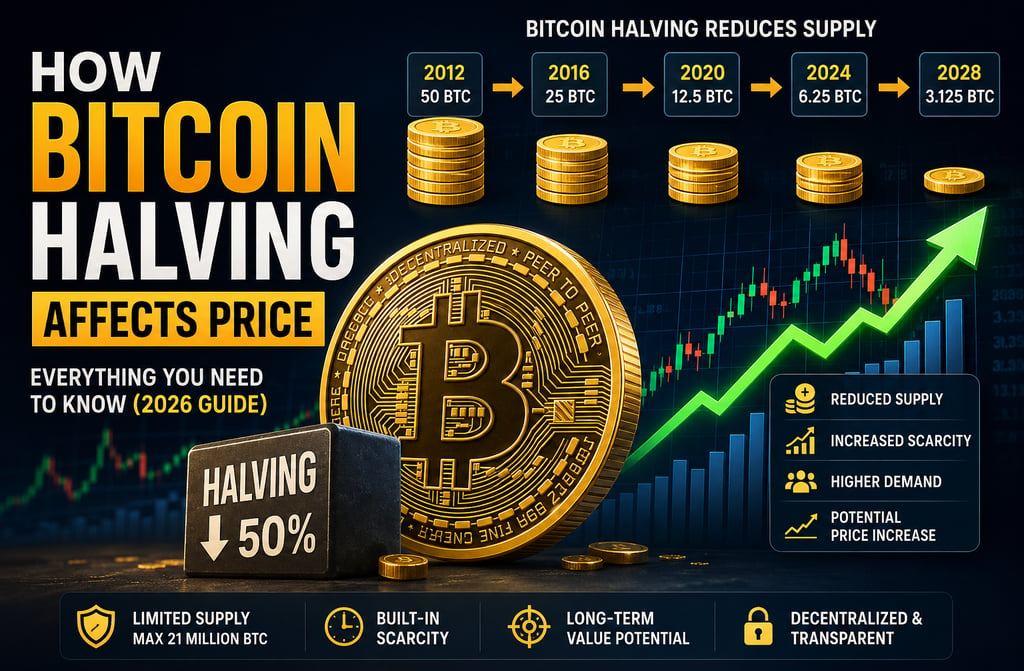
How Bitcoin Halving Affects Price: Everything You Need to Know (2026 Guide)
Bitcoin is the world's largest cryptocurrency, and one of the biggest events in its ecosystem is the Bitcoin halving. Every few years, the reward miners receive for validating transactions is cut in half. This event changes the rate at which new Bitcoin enters circulation and has historically influenced the cryptocurrency's price.
Many investors believe Bitcoin halvings are one of the main reasons behind major bull markets. While no one can predict future prices with certainty, understanding how halving works can help investors make more informed decisions.
In this guide, you'll learn what Bitcoin halving is, why it matters, how it has affected prices in the past, and what factors investors should watch going forward.
Table of Contents
What Is Bitcoin Halving?
Why Does Bitcoin Halving Happen?
How Bitcoin Halving Works
Bitcoin Halving History
How Halving Has Affected Bitcoin Price
Factors That Influence Bitcoin After Halving
Benefits of Bitcoin Halving
Risks and Limitations
Common Myths About Bitcoin Halving
Frequently Asked Questions
Final Thoughts
What Is Bitcoin Halving?
Bitcoin halving is a scheduled event built into Bitcoin's code. Approximately every 210,000 blocks, the reward paid to Bitcoin miners is reduced by 50%.
For example:
50 BTC per block (2009)
25 BTC (2012)
12.5 BTC (2016)
6.25 BTC (2020)
3.125 BTC (2024)
This process continues until the maximum supply of 21 million Bitcoins has been mined.
Why Does Bitcoin Halving Happen?
Unlike traditional currencies, Bitcoin has a fixed supply. Halving helps control inflation by reducing the number of new coins entering the market.
The main objectives include:
Maintaining scarcity
Slowing Bitcoin inflation
Supporting long-term value
Protecting the fixed supply model
Bitcoin's creator designed this system to make Bitcoin resistant to uncontrolled money printing.
How Bitcoin Halving Works
Every time miners successfully add a new block to the blockchain, they receive a block reward.
After each halving:
Miners earn fewer BTC.
The creation of new Bitcoin slows down.
Supply growth decreases.
Scarcity increases over time.
If demand remains strong while new supply decreases, economic theory suggests that prices may rise over time. However, many other market factors also influence Bitcoin's price.
Bitcoin Halving History
Bitcoin has experienced several halvings since its launch. While every cycle has been different, each halving has reduced the rate at which new BTC enters circulation. Historically, major price rallies have occurred after halvings, but past performance does not guarantee future results.
Halving Year Block Reward What Happened
2012 50 BTC → 25 BTC Bitcoin gained broader attention, and its price rose significantly over the following year.
2016 25 BTC → 12.5 BTC Continued adoption and increasing demand contributed to a strong bull market in the years that followed.
2020 12.5 BTC → 6.25 BTC Institutional interest increased, and Bitcoin later reached new all- time highs during the market cycle.
2024 6.25 BTC → 3.125 BTC The supply issuance was reduced again, with investors closely watching how demand, adoption, and macroeconomic conditions influence future price movements.
How Bitcoin Halving Has Affected Price
One of the biggest reasons investors pay attention to Bitcoin halving is its potential impact on price.
When fewer new Bitcoins are created each day, selling pressure from miners can decrease. If demand stays the same or grows while supply growth slows, prices may increase over time. However, Bitcoin's price is also influenced by many other factors, including investor sentiment, regulations, liquidity, and the broader economy.
1. Reduced Supply Growth
Bitcoin's limited supply is one of its strongest features.
After each halving:
Fewer new Bitcoins are produced.
Inflation decreases.
Scarcity increases.
The annual supply growth rate becomes lower.
This makes Bitcoin different from many traditional currencies, where the money supply can expand more rapidly.
2. Increased Market Attention
Every halving attracts significant media coverage.
As awareness grows:
More retail investors become interested.
Financial institutions may increase research and participation.
Search interest often rises.
Bitcoin receives additional exposure across news and social media.
Greater attention can increase demand, although it does not guarantee higher prices.
3. Investor Psychology
Markets are influenced by expectations.
Many investors expect Bitcoin to perform well after a halving because previous cycles showed strong long-term gains. This belief itself can increase buying activity before and after the event.
Still, expectations can already be reflected in the market price before the halving occurs.
Why Scarcity Matters
Bitcoin has a maximum supply of 21 million coins.
No government or company can create additional Bitcoin beyond this limit.
Because of this scarcity, many investors compare Bitcoin to precious metals like gold.
As new supply becomes increasingly limited:
Existing coins may become more valuable if demand grows.
Long-term holders often view Bitcoin as a scarce digital asset.
Investors may consider Bitcoin as part of a diversified portfolio, depending on their goals and risk tolerance.
Other Factors That Influence Bitcoin Price
Halving is important, but it is not the only factor affecting Bitcoin.
Other major influences include:
Institutional Adoption
When companies, investment funds, or financial institutions increase their exposure to Bitcoin, demand may rise.
Government Regulations
Clear and supportive regulations can improve investor confidence, while restrictive policies may create uncertainty.
Global Economy
Interest rates, inflation, currency movements, and overall economic conditions can all affect investor behavior toward Bitcoin.
Bitcoin ETFs and Financial Products
Greater access to regulated investment products can make Bitcoin more accessible to a wider range of investors, potentially affecting demand.
Market Sentiment
News events, social media discussions, and investor confidence can all influence Bitcoin's short-term price movements.
Does Bitcoin Always Rise After Halving?
The short answer is no.
Although previous halving cycles were followed by substantial price increases over time, there is no guarantee that every future halving will produce the same outcome.
Every market cycle is unique because it is affected by:
Global economic conditions
Interest rates
Regulation
Institutional demand
Market liquidity
Investor sentiment
For this reason, halving should be viewed as one important factor, not a guaranteed predictor of future prices.
Benefits of Bitcoin Halving
Bitcoin halving is one of the most anticipated events in the cryptocurrency market because it reinforces Bitcoin's economic design. While it does not guarantee higher prices, it offers several long-term benefits.
1. Controls Bitcoin Inflation
Each halving reduces the number of new Bitcoins entering circulation, helping maintain a predictable and gradually decreasing inflation rate.
2. Increases Scarcity
Since Bitcoin has a fixed maximum supply of 21 million coins, every halving makes newly mined Bitcoin even scarcer.
3. Supports Long-Term Value
Many investors believe scarcity combined with growing adoption can strengthen Bitcoin's long-term value proposition, although market performance is never guaranteed.
4. Encourages Efficient Mining
As mining rewards decrease, miners are encouraged to improve efficiency by using better hardware and lower-cost energy sources.
5. Reinforces Bitcoin's Predictable Monetary Policy
Unlike many traditional currencies, Bitcoin follows transparent rules that anyone can verify on the blockchain.
Risks and Limitations
Despite its importance, Bitcoin halving also comes with risks.
Higher Price Volatility
Bitcoin can experience significant price swings before and after a halving event.
Mining Pressure
Lower block rewards may reduce profitability for miners with higher operating costs.
Market Expectations
Because halving dates are known years in advance, investors may already price in expected effects before the event occurs.
External Factors
Bitcoin's price is influenced by many variables beyond halving, including:
Interest rates
Inflation
Government regulations
Global economic conditions
Institutional adoption
Investor sentiment
Common Myths About Bitcoin Halving
Myth 1: Bitcoin Always Doubles Immediately After Halving
Reality: There is no guarantee of immediate price increases. Historical gains have unfolded over extended periods and under different market conditions.
Myth 2: Halving Creates New Demand
Reality: Halving reduces the growth of new supply. Demand still depends on investors, businesses, institutions, and overall market conditions.
Myth 3: Bitcoin Can Be Printed Like Traditional Money
Reality: Bitcoin has a hard cap of 21 million coins, making its monetary policy fundamentally different from fiat currencies.
Frequently Asked Questions (FAQs)
What is Bitcoin halving?
Bitcoin halving is a scheduled event that cuts miners' block rewards by 50%, reducing the rate at which new Bitcoin is created.
How often does Bitcoin halving occur?
Approximately every 210,000 blocks, which is about every four years.
Why is Bitcoin halving important?
It slows the issuance of new Bitcoin, reinforces scarcity, and is considered an important part of Bitcoin's long-term economic model.
Does Bitcoin always increase in price after halving?
No. While previous halving cycles were followed by strong price appreciation over time, future performance is uncertain and depends on many factors.
Will Bitcoin ever stop being mined?
Yes. As the supply approaches 21 million BTC, block rewards will eventually reach zero. At that point, miners are expected to earn revenue primarily from transaction fees.
Final Thoughts
Bitcoin halving is one of the defining features of the Bitcoin network. By reducing the creation of new coins on a fixed schedule, it helps preserve scarcity and supports Bitcoin's transparent monetary policy.
Although historical halvings have been associated with significant long-term market cycles, investors should remember that no single event determines Bitcoin's future price. Adoption, regulation, macroeconomic conditions, technological developments, and investor sentiment all play important roles.
Understanding how halving works allows investors to make more informed decisions and view Bitcoin from a long-term perspective rather than relying on short-term market speculation.
CryptoFinora
Your trusted source for crypto news, blockchain guides, Bitcoin analysis, and personal finance insight.
COMMUNICATION
muneebrehman2224@gmail.com
© 2026 CryptoFinora. All Rights Reserved - Trusted Crypto & Finance Insights.