How Stablecoins Work: Complete Beginner's Guide to Stablecoins in 2026
Learn how stablecoins work, their types, benefits, risks, and why they play a crucial role in cryptocurrency and digital payments in 2026.
CRYPTO
CryptoFinora Team
7/11/20268 min read

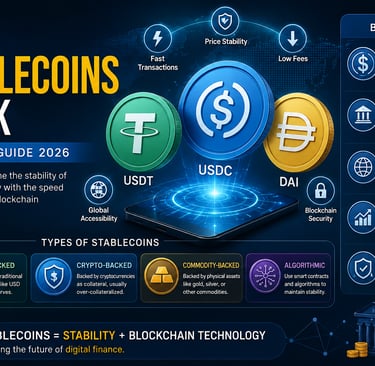
How Stablecoins Work: Complete Beginner's Guide to Stablecoins in 2026
Cryptocurrency has transformed the financial world over the past decade, offering decentralized alternatives to traditional money. However, one major challenge has always limited widespread adoption—price volatility. A cryptocurrency can gain or lose significant value within hours, making it difficult to use for everyday payments or long-term financial planning.
This is where stablecoins come in.
Stablecoins are designed to combine the speed and transparency of blockchain technology with the stability of traditional currencies like the US Dollar or Euro. They provide a bridge between the crypto ecosystem and the traditional financial system, making digital payments, trading, and international transfers more practical.
Whether you're a beginner entering crypto for the first time or an experienced investor looking to understand the backbone of decentralized finance (DeFi), learning how stablecoins work is essential.
In this comprehensive guide, you'll discover everything you need to know about stablecoins in 2026, including their types, benefits, risks, and real-world applications.
Table of Contents
What Are Stablecoins?
Why Stablecoins Were Created
How Stablecoins Work
Different Types of Stablecoins
Popular Stablecoins in 2026
Benefits of Stablecoins
Risks and Challenges
Stablecoins vs Bitcoin
Real-Life Uses
Future of Stablecoins
Frequently Asked Questions
Conclusion
What Are Stablecoins?
A stablecoin is a type of cryptocurrency designed to maintain a relatively stable value instead of experiencing the extreme price fluctuations seen in assets like Bitcoin or Ethereum.
Most stablecoins are linked (or pegged) to a stable asset such as:
US Dollar (USD)
Euro (EUR)
British Pound (GBP)
Gold
Government Treasury Assets
Other Financial Instruments
For example:
1 USDT ≈ $1
1 USDC ≈ $1
The primary goal is simple:
One stablecoin should remain close to the value of the asset it represents.
This stability makes stablecoins ideal for payments, trading, savings, and decentralized finance applications.
Why Were Stablecoins Created?
Early cryptocurrencies solved many financial problems but introduced a new one—unpredictable prices.
Imagine buying a laptop for 0.03 BTC today.
Tomorrow, Bitcoin rises by 15%.
Now you've effectively spent much more than intended.
Or imagine receiving your salary in Bitcoin, only to lose 20% of its value before payday ends.
These situations make daily transactions difficult.
Stablecoins solve this problem by maintaining a consistent value while still benefiting from blockchain technology.
They allow users to:
Send money globally
Store digital wealth
Trade cryptocurrencies
Avoid market volatility
Access decentralized financial services
Without stablecoins, today's crypto economy would function much less efficiently.
How Stablecoins Work
Understanding how stablecoins work starts with understanding the idea of a peg.
A peg is simply a target value.
For example:
1 Stablecoin = 1 US Dollar
To keep this value stable, different projects use different mechanisms.
Some keep actual cash in bank accounts.
Others hold cryptocurrencies as collateral.
Some use algorithms that automatically adjust supply.
The objective remains the same:
Maintain a price close to $1 regardless of market conditions.
The Three Main Components Behind Stablecoins
1. Reserve Assets
Many stablecoins keep reserves.
These reserves may include:
Cash
Treasury Bills
Bank Deposits
Short-Term Government Bonds
These assets back every token issued.
If users redeem stablecoins, reserve assets help maintain confidence.
2. Blockchain Technology
Stablecoins exist on blockchain networks such as:
Ethereum
Solana
Tron
BNB Chain
Polygon
Because of blockchain technology, users can:
Transfer funds 24/7
Avoid banking delays
Reduce international transfer fees
Verify transactions publicly
3. Supply Management
Maintaining a stable price requires careful management of token supply.
If demand rises:
More stablecoins may be issued.
If demand falls:
Tokens may be redeemed or removed from circulation.
This balance helps stabilize the market price.
Why Stablecoins Are Important
Stablecoins have become one of the most important parts of the cryptocurrency ecosystem.
Today they are used for:
Crypto trading
International business payments
Freelance salaries
Cross-border remittances
DeFi lending
Online shopping
Wealth preservation in countries with high inflation
Many traders even convert volatile cryptocurrencies into stablecoins during market downturns instead of withdrawing to traditional bank accounts.
Key Features of Stablecoins
Here are the characteristics that make stablecoins unique:
Stable Value
Unlike Bitcoin, stablecoins aim to maintain a consistent price.
Fast Transactions
Transfers often take seconds or minutes.
Lower Fees
International transfers can cost significantly less than traditional banking methods.
Global Access
Anyone with internet access and a crypto wallet can use stablecoins.
Blockchain Security
Transactions are recorded on transparent blockchain networks.
Easy Conversion
Users can quickly exchange stablecoins for other cryptocurrencies on supported exchanges.
Are Stablecoins Really Stable?
Although stablecoins are designed to remain stable, no stablecoin is completely risk-free.
A stablecoin may temporarily trade above or below its target price because of:
High market demand
Large-scale selling
Liquidity shortages
Regulatory announcements
Reserve concerns
Well-managed stablecoins usually return close to their intended value relatively quickly, but understanding these risks is important before using them.
The 4 Main Types of Stablecoins
Not all stablecoins maintain their value in the same way. Understanding the different types helps investors choose the right option based on their needs and risk tolerance.
1. Fiat-Backed Stablecoins
Fiat-backed stablecoins are the most common and easiest to understand. Every token is backed by traditional currency reserves such as the US Dollar or Euro.
For example, if a company issues 10 million stablecoins pegged to the US Dollar, it should hold approximately 10 million dollars or equivalent liquid assets in reserve.
How They Work
Users deposit traditional money.
The issuer creates (mints) an equal number of stablecoins.
When users redeem their stablecoins, the tokens are burned, and the fiat currency is returned.
Advantages
Simple and reliable.
Easy for beginners.
Widely accepted across exchanges.
Low price volatility.
Disadvantages
Depends on centralized companies.
Requires trust in reserve management.
Subject to financial regulations.
2. Crypto-Backed Stablecoins
Instead of traditional currency, these stablecoins are backed by cryptocurrencies such as Ethereum.
Since cryptocurrencies are volatile, issuers usually require over-collateralization.
For example:
To create $100 worth of stablecoins, users may need to lock $150–$200 worth of Ethereum as collateral.
This extra collateral protects the system if crypto prices fall.
Advantages
More decentralized.
Transparent on blockchain.
No reliance on banks.
Disadvantages
More complex.
Collateral value can fluctuate.
Liquidation risk during sharp market declines.
3. Commodity-Backed Stablecoins
Some stablecoins are backed by physical assets such as:
Gold
Silver
Precious metals
Each token represents ownership of a portion of the stored asset.
These stablecoins appeal to investors who want blockchain convenience while maintaining exposure to traditional stores of value.
Advantages
Protection against inflation.
Linked to tangible assets.
Useful for long-term wealth preservation.
Disadvantages
Storage costs.
Custody risks.
Less common than USD-backed stablecoins.
4. Algorithmic Stablecoins
Algorithmic stablecoins do not rely on cash or crypto reserves. Instead, they use computer algorithms and smart contracts to automatically adjust the token supply.
If demand increases:
➡ More tokens are created.
If demand decreases:
➡ Tokens are removed from circulation.
The goal is to maintain a stable market price through supply and demand.
Advantages
Highly decentralized.
No traditional reserves required.
Innovative blockchain design.
Disadvantages
Higher risk.
Can lose their price peg during extreme market conditions.
More vulnerable to market panic.
Popular Stablecoins in 2026
Several stablecoins dominate the cryptocurrency market due to their liquidity, adoption, and reliability.
USDT (Tether)
USDT is the world's most widely used stablecoin. It is available on multiple blockchain networks and is commonly used for crypto trading, international transfers, and digital payments.
Best For
Trading cryptocurrencies
Fast global transfers
High liquidity
USDC
USDC is known for its strong transparency and regulatory compliance. It is widely used by institutions, businesses, and decentralized finance (DeFi) platforms.
Best For
Businesses
Institutional investors
Secure digital payments
DAI
DAI is a decentralized stablecoin backed by cryptocurrency collateral rather than traditional fiat reserves.
It is managed through smart contracts, making it a popular choice within the decentralized finance ecosystem.
Best For
DeFi users
Blockchain developers
Decentralized applications
USDT vs USDC vs DAI
Feature
USDT
USDC
DAI
Backed By
Fiat Reserves
Fiat Reserves
Crypto Collateral
Centralized
Yes
Yes
Mostly Decentralized
Main Use
Trading
Payments
DeFi
Stability
High
High
High
Transparency
Moderate
Very High
High
Benefits of Stablecoins
Stablecoins have become a key part of the digital economy because they combine the efficiency of blockchain technology with the stability of traditional money.
1. Lower Transaction Costs
International bank transfers can be expensive.
Stablecoins often reduce fees significantly, making them ideal for cross-border payments.
2. Fast Global Payments
Traditional international transfers may take several business days.
Stablecoin transfers often settle within minutes, depending on the blockchain network.
3. Reduced Price Volatility
Unlike many cryptocurrencies, stablecoins are designed to maintain a relatively stable value.
This makes them useful for everyday transactions and preserving purchasing power.
4. Access to Decentralized Finance (DeFi)
Stablecoins are widely used in DeFi applications, allowing users to:
Lend digital assets.
Borrow funds.
Earn interest.
Provide liquidity.
Participate in decentralized exchanges.
5. Safe Haven During Market Volatility
When crypto markets become highly volatile, many investors temporarily convert their holdings into stablecoins instead of exiting the crypto ecosystem entirely.
This strategy helps reduce exposure to rapid price fluctuations while keeping funds readily available for future investments.
Risks and Challenges of Stablecoins
Although stablecoins are designed to provide price stability, they are not entirely risk-free. Before investing or using them, it's important to understand the potential challenges.
1. Regulatory Uncertainty
Governments around the world are introducing new rules for stablecoins to protect consumers and maintain financial stability. Future regulations could affect how stablecoins are issued, traded, or used.
Potential Impact:
Stricter compliance requirements
Licensing for issuers
Changes in how stablecoins operate
2. Reserve Transparency
For fiat-backed stablecoins, trust depends on whether the issuer actually holds enough reserves to back every token in circulation.
Choosing stablecoins that publish regular reserve reports and independent audits can increase confidence.
3. Smart Contract Risks
Stablecoins operating on blockchain networks rely on smart contracts. Like any software, vulnerabilities or coding errors can lead to security issues if not properly audited.
4. De-Pegging Risk
A stablecoin is designed to stay close to its target value, but extreme market conditions can cause it to temporarily lose its peg.
This is known as de-pegging, where the price moves above or below its intended value (for example, $1).
Stablecoins vs Bitcoin
Although both are cryptocurrencies, they serve very different purposes.
Feature
Stablecoins
Bitcoin
Price Stability
High
Highly Volatile
Main Purpose
Payments & Value Transfer
Investment & Store of Value
Daily Spending
Excellent
Less Practical
Risk Level
Lower
Higher
Long-Term Growth Potential
Limited
Higher Potential
In simple terms:
Stablecoins are designed for stability and everyday use.
Bitcoin is primarily viewed as a long-term investment and digital store of value.
Many investors use both together—Bitcoin for potential growth and stablecoins for preserving value and making transactions.
Real-World Uses of Stablecoins
Stablecoins have expanded far beyond crypto trading. Today, they are used in many practical ways around the world.
International Money Transfers
People can send funds across borders quickly and often at lower costs than traditional banking services.
Online Shopping
Some businesses accept stablecoins as payment for goods and services, making digital commerce more flexible.
Freelance Payments
Freelancers working with international clients may receive payments in stablecoins because transactions are fast and accessible globally.
Crypto Trading
Traders frequently move funds into stablecoins during periods of market volatility without converting back to traditional currencies.
Decentralized Finance (DeFi)
Stablecoins are widely used for lending, borrowing, liquidity pools, and earning yield within DeFi platforms.
The Future of Stablecoins
Stablecoins are expected to play an increasingly important role in the global financial system.
Key trends include:
Greater institutional adoption
Faster cross-border payment solutions
Growth of blockchain-based financial services
Improved regulatory frameworks
Expansion of tokenized real-world assets (RWAs)
Integration with digital payment systems
As blockchain technology continues to evolve, stablecoins are likely to remain a core component of the digital economy.
Frequently Asked Questions (FAQ)
What is a stablecoin?
A stablecoin is a cryptocurrency designed to maintain a stable value by being linked to an asset such as the US Dollar, Euro, or other reserves.
Are stablecoins safe?
Many well-established stablecoins are considered relatively stable, but they still carry risks such as regulatory changes, reserve management concerns, and market disruptions.
Can stablecoins increase in value?
Most stablecoins are intended to maintain a fixed value rather than appreciate in price. Their primary purpose is stability, not investment growth.
Which stablecoin is best for beginners?
The answer depends on individual needs. Many beginners choose widely used stablecoins with strong transparency and broad market support.
Why do crypto traders use stablecoins?
Stablecoins allow traders to reduce exposure to market volatility while keeping funds within the cryptocurrency ecosystem for quick trading opportunities.
Final Thoughts
Stablecoins have become one of the most important innovations in the cryptocurrency industry. By combining the efficiency of blockchain technology with the stability of traditional currencies, they make digital payments, trading, and decentralized finance more practical for everyday users.
Understanding how stablecoins work is essential for anyone exploring the world of crypto. Whether you're sending money internationally, participating in DeFi, or simply looking for a more stable digital asset, stablecoins offer a useful solution.
However, it's important to research each stablecoin carefully, understand how it is backed, and stay informed about regulatory developments before making financial decisions.
As the crypto industry continues to evolve, stablecoins are expected to remain a cornerstone of digital finance and play a major role in shaping the future of global payments.
CryptoFinora
Your trusted source for crypto news, blockchain guides, Bitcoin analysis, and personal finance insight.
COMMUNICATION
muneebrehman2224@gmail.com
© 2026 CryptoFinora. All Rights Reserved - Trusted Crypto & Finance Insights.