How to Avoid Crypto Rug Pulls in 2026: 12 Warning Signs Every Investor Must Know
Learn how to avoid crypto rug pulls in 2026 with 12 essential warning signs. Discover practical tips to identify crypto scams, protect your investments, and invest safely in cryptocurrency.
CRYPTO
CryptoFinora Team
7/28/20266 min read
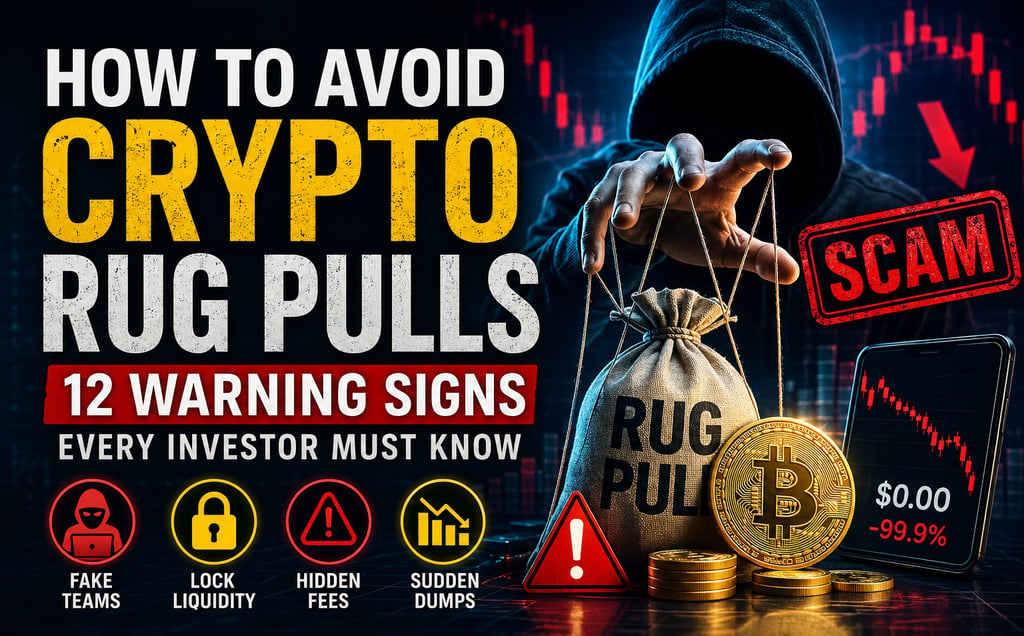
How to Avoid Crypto Rug Pulls in 2026: 12 Warning Signs Every Investor Must Know
The cryptocurrency market continues to grow rapidly in 2026, attracting millions of new investors worldwide. Along with exciting investment opportunities, however, comes a serious risk—crypto rug pulls.
Every year, scammers launch fake crypto tokens, attract investors with unrealistic promises, and then disappear with millions of dollars. Many beginners lose their savings simply because they don't recognize the warning signs early enough.
The good news is that most rug pulls leave clear clues before they happen.
If you know what to look for, you can avoid the majority of crypto scams and protect your investments.
This guide explains exactly how rug pulls work, why they happen, and the 12 biggest warning signs every crypto investor should know in 2026.
What Is a Crypto Rug Pull?
A crypto rug pull is a scam where the developers of a cryptocurrency project suddenly abandon the project after collecting investors' money.
Typically, scammers create excitement through social media, influencer marketing, fake partnerships, and promises of massive profits.
Once enough people buy the token, the developers remove liquidity or sell their entire token supply, causing the token price to collapse almost instantly.
Investors are left holding worthless tokens while the scammers disappear.
Why Rug Pulls Are Still Common in 2026
Although blockchain technology has become more secure, launching a new cryptocurrency token has never been easier.
Today anyone can create a token within minutes on networks like Ethereum, BNB Chain, Solana, or Base.
Unfortunately, scammers take advantage of this simplicity.
Some reasons rug pulls continue to happen include:
Lack of investor research
Fear of Missing Out (FOMO)
Anonymous development teams
Viral marketing on social media
AI-generated fake websites and whitepapers
Fake influencer promotions
Because thousands of new tokens launch every month, investors often rush into projects without verifying whether they are legitimate.
Why Beginners Lose Money
Most beginners focus only on one question:
"How much can I make?"
Professional investors ask a different question:
"How much can I lose?"
That simple mindset shift helps experienced investors avoid many scams.
Scammers know that greed often overcomes caution, especially when people see promises like:
100x returns
Guaranteed profits
Risk-free investing
Limited-time opportunity
Next Bitcoin
In reality, legitimate investments never guarantee profits.
Warning Sign #1: Anonymous Development Team
One of the biggest red flags is an anonymous team.
While some genuine crypto founders remain private, completely anonymous teams increase the risk significantly.
Before investing, check:
LinkedIn profiles
Previous blockchain projects
GitHub activity
Interviews
Public appearances
Community engagement
If you cannot verify who created the project, think twice before investing.
Warning Sign #2: Unrealistic Profit Promises
Be extremely cautious when a project guarantees returns.
Examples include:
Earn 20% daily
Guaranteed passive income
Double your investment
Risk-free staking
Lifetime rewards
Crypto investing always involves risk.
Any project claiming guaranteed profits should immediately raise concerns.
Warning Sign #3: No Liquidity Lock
Liquidity is essential for buying and selling crypto tokens.
Many scammers remove liquidity after attracting investors.
Always check whether liquidity has been locked.
Locked liquidity makes it much harder for developers to steal investor funds.
If liquidity isn't locked, that's a major warning sign.
Warning Sign #4: Smart Contract Has Never Been Audited
A smart contract audit is one of the strongest indicators that a crypto project takes security seriously.
Independent cybersecurity firms review a project's code to identify vulnerabilities, hidden functions, and potential exploits before investors are affected.
While an audit does not guarantee a project is legitimate, the absence of any audit significantly increases the risk.
Before investing, check:
Has the smart contract been audited?
Which company performed the audit?
Is the audit report publicly available?
Were any critical issues fixed?
If the team refuses to share an audit or claims it's "coming soon" for months, proceed with caution.
Warning Sign #5: Token Distribution Is Highly Centralized
Healthy crypto projects distribute tokens across many holders.
Scam projects often keep a huge percentage of tokens in just a few wallets.
This allows developers to dump massive amounts of tokens onto the market at any time.
Look for these red flags:
One wallet owns more than 30–40% of the supply.
Developer wallets hold excessive amounts.
Most tokens haven't entered circulation.
Wallet ownership information is hidden.
Always review token distribution before buying.
Warning Sign #6: No Clear Utility
Many scam tokens have impressive branding but no real purpose.
Ask yourself:
What problem does this project solve?
Why does the token exist?
Will people actually use it?
Does the ecosystem need this token?
If the only selling point is "the price will go up," it's a major warning sign.
Strong crypto projects offer genuine utility, whether through payments, decentralized finance (DeFi), gaming, infrastructure, or real-world asset tokenization.
Warning Sign #7: Fake Community Engagement
Large follower counts don't always mean a project is trustworthy.
Scammers frequently buy fake followers, likes, and comments to appear popular.
Signs of an artificial community include:
Thousands of followers but almost no real discussions.
Generic comments like "Amazing project!"
Repetitive messages from different accounts.
Admins deleting reasonable questions.
No transparency during community chats.
A genuine community asks questions, shares feedback, and discusses the project's progress.
Warning Sign #8: Aggressive Marketing and FOMO
Scam projects rely on emotion rather than facts.
Common marketing phrases include:
"Last chance!"
"100x opportunity!"
"Buy before it's too late!"
"Don't miss the next Bitcoin!"
"Guaranteed moonshot!"
Professional investment decisions should never be based on urgency or hype.
If a project focuses more on marketing than technology, be careful.
Warning Sign #9: Missing or Poor Whitepaper
A whitepaper explains how a crypto project works, its goals, tokenomics, roadmap, and technical design.
A weak whitepaper often includes:
Vague promises.
Copied content from other projects.
No technical details.
Unrealistic roadmaps.
Poor grammar and formatting.
No explanation of token economics.
Read the whitepaper before investing. If it lacks substance, that's a serious warning sign.
Tools to Help You Detect Crypto Scams
Before investing in any new cryptocurrency, use trusted research tools:
CoinMarketCap – Check token details, market cap, and trading volume.
CoinGecko – Compare market data and community metrics.
Etherscan, BscScan, or Solscan – Inspect wallet activity and token holders.
DefiLlama – Review DeFi project metrics and total value locked (TVL).
Token Sniffer – Analyze smart contract risks and suspicious token behavior.
Using multiple sources helps you build a clearer picture before investing.
Quick Rug Pull Prevention Checklist
Before buying any new token, ask yourself:
✅ Is the development team identifiable?
✅ Has the smart contract been audited?
✅ Is liquidity locked?
✅ Are token holdings well distributed?
✅ Does the project have real utility?
✅ Is the whitepaper detailed and original?
✅ Is the community active and authentic?
✅ Are promises realistic?
✅ Have you researched independently?
If you answer "No" to several of these questions, reconsider investing.
Warning Sign #10: No Clear Roadmap or Development Updates
A legitimate crypto project continuously improves its platform and keeps its community informed.
If months pass without updates, code commits, or product releases, it may indicate that the developers have abandoned the project—or worse, planned a scam from the start.
Look for:
Regular development updates
Public roadmap milestones
Active GitHub repository
Product demos or beta releases
Transparent communication from the team
A roadmap should show real progress, not just ambitious promises.
Warning Sign #11: Suspicious Tokenomics
Tokenomics explains how a cryptocurrency is created, distributed, and used.
Poor tokenomics often lead to price manipulation.
Watch out for:
Extremely high transaction taxes (15–30% or more)
Unlimited token supply
Hidden developer wallets
Excessive token minting
Unfair allocations to insiders
Healthy tokenomics are transparent, balanced, and designed for long-term sustainability.
Warning Sign #12: You Can't Sell the Token
One of the biggest signs of a scam is when investors can buy a token but cannot sell it.
This is commonly known as a honeypot scam.
Red flags include:
Buy transactions succeed, but sell transactions fail.
Very high selling fees.
Trading is suddenly disabled.
Only selected wallets can sell.
Before investing in a newly launched token, research whether other investors have successfully sold it.
Real-World Lessons from Crypto Rug Pulls
Many rug pulls have followed the same pattern:
A new token launches with heavy marketing.
Social media influencers create hype.
Thousands of investors buy in quickly.
Developers disappear or remove liquidity.
The token price crashes within hours or days.
These incidents remind investors that research is more important than hype.
Best Practices to Stay Safe
Protect your investments by following these habits:
Never invest money you cannot afford to lose.
Diversify instead of putting all funds into one token.
Verify information from multiple trusted sources.
Be skeptical of guaranteed returns.
Store long-term holdings in secure wallets.
Enable two-factor authentication (2FA) on exchange accounts.
Keep your recovery phrase offline and never share it.
Patience and research are often the best defenses against scams.
Frequently Asked Questions (FAQs)
What is a crypto rug pull?
A crypto rug pull is a scam where developers abandon a project or remove liquidity after attracting investors, causing the token's value to collapse.
Can I recover money after a rug pull?
In most cases, recovering funds is extremely difficult. Prevention through careful research is far more effective than trying to recover lost money.
Are audited crypto projects always safe?
No. An audit reduces certain technical risks, but it does not guarantee that a project is honest or financially sound. You should also evaluate the team, tokenomics, utility, and community.
How can beginners avoid crypto scams?
Research every project, verify the development team, review token distribution, read the whitepaper, and avoid investing based solely on hype or influencer recommendations.
What is the biggest warning sign?
A combination of anonymous developers, unrealistic profit promises, unlocked liquidity, and no real product should be treated as a major red flag.
Final Thoughts
The crypto industry continues to offer exciting opportunities, but it also attracts scammers looking to exploit inexperienced investors. Understanding the warning signs of a rug pull can help you make smarter decisions and protect your capital.
Before investing in any cryptocurrency project, take time to research the team, verify the technology, analyze the tokenomics, and assess the community. A few minutes of due diligence can save you from significant financial losses.
Remember, successful investing isn't about chasing every new token—it's about identifying projects with transparency, real-world value, and long-term potential.
CryptoFinora
Your trusted source for crypto news, blockchain guides, Bitcoin analysis, and personal finance insight.
COMMUNICATION
muneebrehman2224@gmail.com
© 2026 CryptoFinora. All Rights Reserved - Trusted Crypto & Finance Insights.