How to Build a Crypto Portfolio in 2026: Complete Beginner's Guide
Learn how to build a diversified crypto portfolio in 2026 with Bitcoin, Ethereum, AI coins, DeFi, and Layer-2 projects. Complete beginner's investment guide.
CRYPTO
CryptoFinora Team
7/5/20267 min read
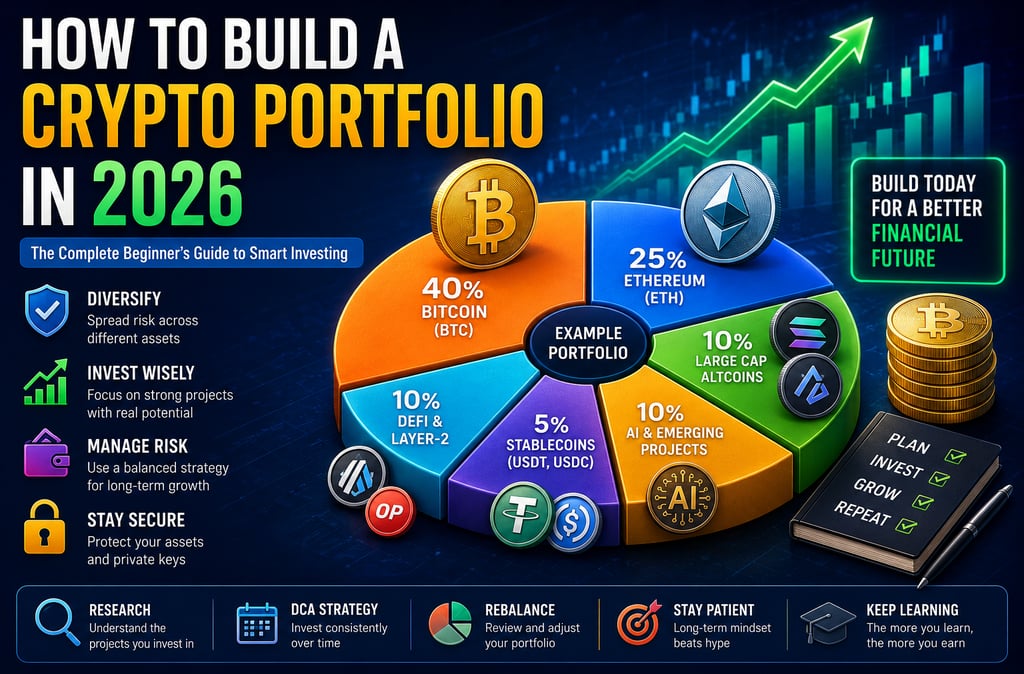
How to Build a Crypto Portfolio in 2026: The Complete Beginner's Guide to Smart Investing
Focus Keyword: How to Build a Crypto Portfolio in 2026
Secondary Keywords: Crypto portfolio for beginners, Best crypto portfolio 2026, Crypto investment strategy, Diversified crypto portfolio, Bitcoin and Ethereum portfolio, Long-term crypto investing.
Introduction
Cryptocurrency has become one of the fastest-growing investment markets in the world. With thousands of digital assets available, many beginners struggle with one simple question: How do you build a crypto portfolio that balances growth and risk?
A well-diversified crypto portfolio can help reduce risk while maximizing long-term returns. Instead of relying on a single cryptocurrency, smart investors spread their investments across different sectors of the crypto market.
In this complete guide, you'll learn how to build a strong crypto portfolio in 2026, choose the right assets, manage risk, and avoid common mistakes that can hurt your investment journey.
What Is a Crypto Portfolio?
A crypto portfolio is a collection of cryptocurrencies that you own. Rather than investing all your money into one coin, a portfolio contains multiple assets with different purposes and risk levels.
For example, your portfolio might include:
Bitcoin for long-term stability
Ethereum for smart contracts
Solana for high-speed blockchain applications
Chainlink for decentralized oracle services
Stablecoins for cash management
AI-focused cryptocurrencies for future growth
A balanced portfolio helps protect you if one investment underperforms.
Why Diversification Is Important
One of the biggest mistakes beginners make is putting all their money into a single cryptocurrency.
Diversification offers several benefits:
Reduces overall investment risk
Protects against major losses in one asset
Increases exposure to multiple growth sectors
Creates more stable long-term returns
Helps investors stay disciplined during market volatility
Remember the old investing principle: Don't put all your eggs in one basket.
Understanding Risk Before You Invest
Every cryptocurrency carries some level of risk.
Low-Risk Assets
These are generally well-established cryptocurrencies with larger market capitalizations.
Examples:
Bitcoin (BTC)
Ethereum (ETH)
Medium-Risk Assets
Projects with strong ecosystems but greater price volatility.
Examples:
Solana
Avalanche
Chainlink
XRP
High-Risk Assets
Smaller or emerging projects with the potential for higher returns but also greater downside.
Examples:
AI tokens
Gaming tokens
New Layer-2 projects
Early-stage blockchain startups
A balanced portfolio should include a mix of these categories based on your risk tolerance.
Step 1: Define Your Investment Goals
Before buying any cryptocurrency, ask yourself:
Are you investing for 1 year, 5 years, or longer?
Do you want steady growth or higher-risk opportunities?
How much money can you comfortably invest?
Can you handle significant market volatility?
Your answers will determine the type of portfolio that's right for you.
Step 2: Decide Your Portfolio Allocation
A sample allocation for beginners could look like this:
Asset
Allocation
Bitcoin
40%
Ethereum
25%
Large-Cap Altcoins
20%
AI & Emerging Projects
10%
Stablecoins
5%
This allocation provides exposure to market leaders while allowing room for higher-growth opportunities.
Step 3: Build Around Bitcoin
Bitcoin is often referred to as the "digital gold" of the crypto market.
Why include Bitcoin?
Largest cryptocurrency by market capitalization
Strong institutional adoption
Limited supply of 21 million coins
High liquidity
Long-term growth potential
Many experienced investors make Bitcoin the foundation of their portfolios.
Step 4: Add Ethereum for Growth
Ethereum is the world's leading smart contract blockchain.
Its ecosystem supports:
Decentralized Finance (DeFi)
NFTs
Web3 applications
Stablecoins
AI-powered blockchain projects
Enterprise solutions
Ethereum complements Bitcoin by offering exposure to blockchain innovation.
Step 5: Invest in High-Quality Altcoins
Once you've allocated funds to Bitcoin and Ethereum, consider adding established altcoins such as:
Solana
Avalanche
Chainlink
Arbitrum
Sui
Render
Bittensor
Choose projects with active development, strong communities, and real-world use cases rather than chasing short-term hype.
Mistakes to Avoid
Avoid these common errors:
Investing based on social media hype
Buying coins without research
Ignoring diversification
Investing money you can't afford to lose
Panic selling during market dips
Step 6: Invest in Different Crypto Sectors
A smart crypto portfolio isn't just diversified by coins—it’s also diversified by sectors. Different sectors often perform differently during various market cycles.
1. Store of Value
These are established cryptocurrencies that many investors hold for the long term.
Examples:
Bitcoin (BTC)
Suggested Allocation: 35–45%
2. Smart Contract Platforms
These blockchains power decentralized applications (dApps), NFTs, DeFi platforms, and Web3 services.
Examples:
Ethereum (ETH)
Solana (SOL)
Avalanche (AVAX)
Sui (SUI)
Suggested Allocation: 25–35%
3. Artificial Intelligence (AI) Crypto
AI is one of the fastest-growing industries, and blockchain projects focused on AI continue attracting investors.
Examples:
Render (RENDER)
Bittensor (TAO)
Suggested Allocation: 5–15%
4. DeFi (Decentralized Finance)
DeFi platforms allow users to lend, borrow, trade, and earn rewards without traditional banks.
Benefits include:
Passive income opportunities
Financial innovation
Global accessibility
High growth potential
5. Layer-2 Solutions
Layer-2 networks improve blockchain scalability by reducing fees and increasing transaction speed.
Popular projects include:
Arbitrum
Optimism
Base ecosystem projects
These networks are expected to play a major role as blockchain adoption continues to grow.
Step 7: Use Dollar-Cost Averaging (DCA)
Trying to buy at the perfect price is nearly impossible.
Instead, many experienced investors use Dollar-Cost Averaging (DCA).
Example
Instead of investing $1,200 all at once:
Invest $100 every month for 12 months.
Benefits of DCA
Reduces emotional investing
Minimizes the impact of volatility
Builds discipline
Helps avoid buying only at market peaks
Step 8: Rebalance Your Portfolio
Over time, some cryptocurrencies may grow much faster than others.
For example:
Original Portfolio:
Bitcoin – 40%
Ethereum – 30%
Altcoins – 30%
After a strong bull market:
Bitcoin – 55%
Ethereum – 25%
Altcoins – 20%
Rebalancing means adjusting your holdings to return to your target allocation, helping you manage risk and maintain your investment strategy.
Many long-term investors review and rebalance their portfolios every 3–6 months.
Step 9: Protect Your Investments
Buying crypto is only part of the process. Keeping it secure is equally important.
Security Tips
Enable Two-Factor Authentication (2FA)
Use strong, unique passwords
Store recovery phrases offline
Beware of phishing websites and fake apps
Avoid sharing wallet details publicly
Keep software and wallets updated
Good security habits can protect your investments from theft and scams.
Step 10: Keep Learning
The crypto industry evolves rapidly. Stay informed by following:
Blockchain technology updates
Major cryptocurrency news
Market trends
Regulatory developments
New project launches
Continuous learning helps you make better investment decisions over time.
Sample Crypto Portfolio for Beginners
Asset
Percentage
Bitcoin
40%
Ethereum
25%
Solana
10%
Chainlink
7%
Avalanche
5%
AI Crypto Projects
8%
Stablecoins
5%
This example balances stability with growth opportunities.
Common Portfolio Mistakes
Many investors lose money not because they choose bad projects, but because they make avoidable mistakes.
Avoid These Errors
Investing without a clear plan
Buying coins due to fear of missing out (FOMO)
Selling during market panic
Ignoring portfolio diversification
Checking prices every few minutes
Investing based on rumors
Using borrowed money to invest
Failing to take profits when appropriate
Successful investing requires patience, discipline, and a long-term mindset.
Signs of a Healthy Crypto Portfolio
A well-structured portfolio should:
Include multiple high-quality assets
Balance risk and reward
Be reviewed regularly
Have a clear investment strategy
Focus on long-term growth rather than short-term speculation
Advanced Tips for Long-Term Crypto Investors
Once you've built a diversified portfolio, the next step is maintaining it wisely. Successful investors focus on discipline rather than chasing every new trend.
Invest with a Long-Term Mindset
Cryptocurrency markets can be highly volatile. Instead of reacting to daily price movements, focus on projects with strong fundamentals and long-term growth potential.
Avoid Emotional Decisions
Fear and greed are two of the biggest reasons investors lose money.
Avoid making investment decisions because:
A coin is trending on social media.
Prices are rising rapidly.
Friends or influencers recommend a project without evidence.
You fear missing out (FOMO).
Always make decisions based on research rather than emotions.
Bull Market vs Bear Market Strategy
Understanding market cycles can help you make better investment decisions.
During a Bull Market
Stick to your investment plan.
Avoid chasing coins after huge price increases.
Consider taking partial profits as your portfolio grows.
Rebalance your portfolio if one asset becomes too large.
During a Bear Market
Stay patient and avoid panic selling.
Continue investing through Dollar-Cost Averaging (DCA) if it fits your financial plan.
Focus on high-quality projects with active development.
Review your portfolio and remove weak projects if necessary.
Many experienced investors see bear markets as opportunities to accumulate quality assets at lower prices.
When Should You Take Profits?
One common mistake is never taking profits during a strong market.
A simple approach is to define your goals before investing.
For example:
Recover your original investment after significant gains.
Take partial profits at predetermined milestones.
Reinvest profits into lower-risk assets if appropriate.
Having an exit strategy can help reduce emotional decision-making.
How Often Should You Review Your Portfolio?
You don't need to check prices every hour.
A monthly or quarterly review is often enough for long-term investors.
During each review:
Check your asset allocation.
Evaluate project developments.
Remove projects that no longer meet your investment criteria.
Rebalance if necessary.
Crypto Portfolio Checklist
Before investing, ask yourself:
Have I researched each project?
Is my portfolio diversified?
Am I investing money I can afford to lose?
Have I enabled security features such as 2FA?
Do I have a long-term investment plan?
Am I avoiding emotional decisions?
Have I planned when to rebalance and take profits?
If you answered "Yes" to these questions, you're building your portfolio on a stronger foundation.
Frequently Asked Questions (FAQs)
1. How many cryptocurrencies should a beginner own?
Many beginners start with 5–10 carefully selected cryptocurrencies rather than investing in dozens of projects.
2. Should I buy Bitcoin or Ethereum first?
Both are considered leading cryptocurrencies. Many investors begin with Bitcoin and then add Ethereum for additional exposure to blockchain applications.
3. Is diversification important?
Yes. Diversification can reduce risk by spreading investments across different assets and sectors.
4. What percentage of my portfolio should be Bitcoin?
There is no universal rule, but many long-term investors allocate a significant portion of their portfolio to Bitcoin because of its market leadership.
5. What is Dollar-Cost Averaging (DCA)?
DCA is an investment strategy where you invest a fixed amount at regular intervals instead of trying to time the market.
6. Should I invest every month?
Many long-term investors prefer monthly investing because it encourages consistency and reduces emotional decision-making.
7. How risky are AI crypto projects?
AI-related cryptocurrencies may offer higher growth potential, but they are generally more volatile than established assets like Bitcoin and Ethereum.
8. Is it safe to keep crypto on an exchange?
For active trading, exchanges may be convenient. For long-term holdings, many investors prefer secure wallets and strong security practices.
9. Can I build a portfolio with a small budget?
Yes. Many exchanges allow you to buy fractional amounts of cryptocurrencies, making it possible to start with a modest investment.
10. What is the biggest mistake beginners make?
Investing without research, chasing hype, and making emotional decisions are among the most common mistakes.
Final Conclusion
Building a successful crypto portfolio in 2026 isn't about finding one "perfect" coin. It's about creating a balanced investment strategy that aligns with your goals, risk tolerance, and time horizon.
A diversified portfolio built around strong projects like Bitcoin and Ethereum, complemented by carefully selected altcoins in sectors such as AI, Layer-2, and DeFi, can provide exposure to both stability and growth opportunities.
Remember these key principles:
Diversify your investments.
Invest consistently using a plan such as Dollar-Cost Averaging (DCA).
Review and rebalance your portfolio periodically.
Protect your assets with strong security practices.
Focus on long-term value instead of short-term market noise.
Cryptocurrency investing requires patience, continuous learning, and disciplined decision-making. While no strategy can eliminate risk, following these best practices can help you build a portfolio that is better prepared for changing market conditions.
Key Takeaways
Build your portfolio around high-quality cryptocurrencies.
Diversify across different sectors rather than relying on one asset.
Invest regularly instead of trying to predict market highs and lows.
Review your portfolio every few months and rebalance when needed.
Keep learning as the cryptocurrency market evolves.
Never invest more than you can afford to lose.
Disclaimer: This article is for educational purposes only and should not be considered financial or investment advice. Cryptocurrency markets are volatile, and all investments involve risk. Always conduct your own research (DYOR) and consult a qualified financial advisor before making financial decisions.
CryptoFinora
Your trusted source for crypto news, blockchain guides, Bitcoin analysis, and personal finance insight.
COMMUNICATION
muneebrehman2224@gmail.com
© 2026 CryptoFinora. All Rights Reserved - Trusted Crypto & Finance Insights.