How to Identify Crypto Scams Before You Lose Your Money (2026 Guide)
Learn how to spot crypto scams before they steal your money. Discover the warning signs of rug pulls, phishing attacks, fake exchanges, and Ponzi schemes with practical safety tips for 2026.
CRYPTO
CryptoFinora Team
7/12/20265 min read
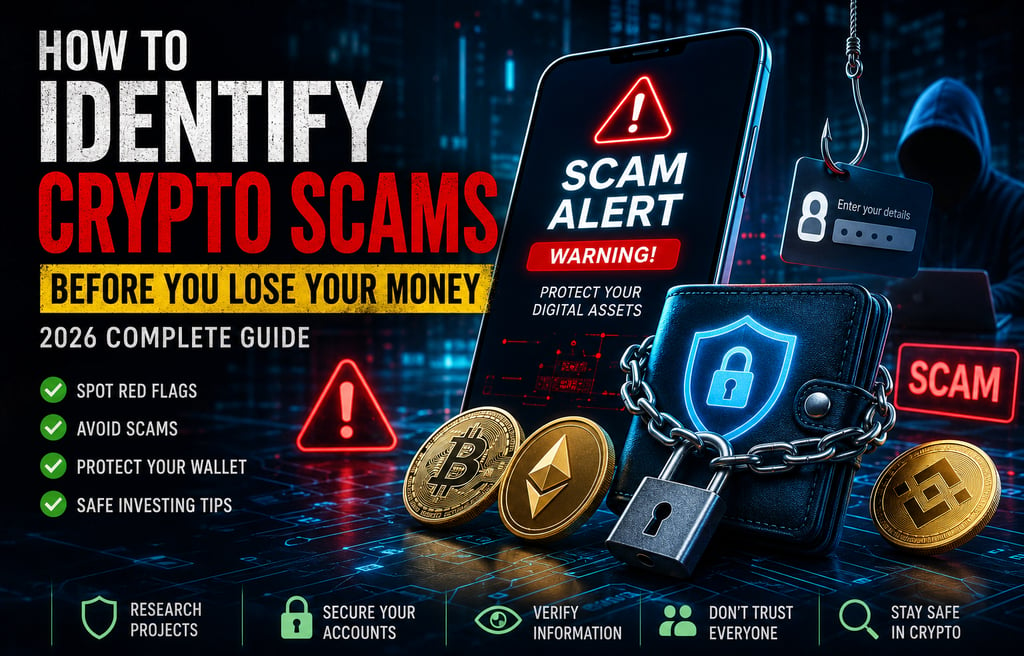
How to Identify Crypto Scams Before You Lose Your Money (2026 Complete Guide)
The cryptocurrency market has created life-changing opportunities for millions of investors. However, as the industry continues to grow, so does the number of scammers looking to exploit beginners and experienced traders alike. Every year, people lose billions of dollars to fake investment platforms, phishing attacks, rug pulls, and fraudulent crypto projects.
The good news is that most crypto scams follow predictable patterns. By learning how these scams work and recognizing the warning signs early, you can significantly reduce your risk of becoming a victim.
This guide explains the most common cryptocurrency scams in 2026, how they operate, and the practical steps you can take to protect your investments.
Table of Contents
1. Why Crypto Scams Are Increasing
2. The Most Common Types of Crypto Scams
3. Red Flags Every Investor Should Notice
4. How to Verify a Crypto Project
5. Essential Security Tips
6. What to Do If You Get Scammed
7. Frequently Asked Questions
8. Final Thoughts
Why Crypto Scams Are Increasing
Cryptocurrency transactions are fast, borderless, and irreversible. While these features make crypto attractive for investors, they also create opportunities for criminals. Once digital assets are sent to a scammer's wallet, recovering them is often extremely difficult.
Scammers also take advantage of trending topics such as AI, meme coins, DeFi, NFTs, and new blockchain launches. They create convincing websites, fake social media accounts, and even professional-looking mobile apps to gain investors' trust.
Many victims are not inexperienced. Even knowledgeable investors can be fooled by sophisticated scams that appear legitimate.
The Most Common Types of Crypto Scams
1. Fake Investment Platforms
Fraudulent websites promise guaranteed daily or weekly profits. They may initially allow small withdrawals to build trust, but once larger amounts are deposited, the platform blocks withdrawals or disappears completely.
2. Rug Pulls
A rug pull happens when developers launch a new cryptocurrency token, attract investors, and then suddenly remove liquidity or abandon the project. The token's value crashes, leaving investors with nearly worthless assets.
3. Phishing Attacks
Scammers send emails, text messages, or social media links that imitate trusted crypto exchanges or wallet providers. Their goal is to steal your wallet's recovery phrase or login credentials.
4. Giveaway Scams
Fake social media accounts pretending to represent famous crypto personalities or exchanges promise to double your cryptocurrency if you send funds first. Legitimate companies never ask users to send crypto to receive more in return.
5. Pump-and-Dump Groups
These groups artificially inflate the price of a low-value cryptocurrency through coordinated buying and misleading promotions. Once the price rises, organizers sell their holdings, causing the token's value to collapse.
Red Flags Every Crypto Investor Should Notice
Many crypto scams can be identified within a few minutes if you know what to look for. Before investing in any cryptocurrency project, watch for these warning signs.
1. Guaranteed Profits
No legitimate investment can promise fixed or guaranteed returns. If a project claims you will earn "10% daily" or "100% risk-free profits," it's almost certainly a scam.
2. Anonymous Team
Reputable crypto projects usually have a public team with verifiable LinkedIn profiles, professional experience, and a visible online presence. If the founders are completely anonymous without a valid reason, proceed with extreme caution.
3. Poor or Missing Whitepaper
A genuine crypto project should explain its technology, tokenomics, roadmap, and goals in a detailed whitepaper. A poorly written document—or no whitepaper at all—is a major red flag.
4. Fake Community Engagement
Some projects buy fake followers and use bots to create the illusion of popularity. A large number of followers does not always mean the project is trustworthy. Check whether the community is active and whether real questions receive meaningful answers.
5. Pressure to Invest Quickly
Scammers often use phrases like:
"Only a few hours left!"
"Last chance to become rich!"
"Limited investment opportunity!"
These tactics are designed to create fear of missing out (FOMO) and stop you from researching the project.
How to Verify a Crypto Project
Before investing, take a few simple steps to reduce your risk.
Research the Development Team
Find out who created the project. Look for public interviews, professional profiles, previous blockchain work, and community involvement.
Read Independent Reviews
Don't rely only on the project's website. Read opinions from trusted crypto publications and experienced community members to understand both the strengths and the risks.
Check the Smart Contract
If the token has been independently audited by a reputable blockchain security company, that's a positive sign. While an audit doesn't guarantee safety, it helps identify potential vulnerabilities.
Review the Tokenomics
Understand:
Total token supply
Circulating supply
Team allocation
Vesting schedule
Utility of the token
Projects with unclear token distribution or excessive insider allocations deserve extra caution.
Study the Roadmap
A serious project usually has realistic milestones, regular development updates, and measurable progress instead of vague promises.
Essential Security Tips
Protecting your cryptocurrency is just as important as choosing the right investment.
Use a Hardware Wallet
If you hold significant amounts of crypto, consider storing your assets in a hardware wallet instead of leaving them on an exchange.
Enable Two-Factor Authentication (2FA)
Always activate 2FA on exchanges and wallets to add another layer of protection.
Never Share Your Recovery Phrase
Your wallet's recovery phrase is the master key to your funds. No legitimate company, exchange, or support agent will ever ask for it.
Verify Website URLs
Always double-check the website address before entering passwords or connecting your wallet. Fake websites often look almost identical to legitimate ones.
Diversify Your Investments
Avoid putting all your money into a single token or project. Diversification helps reduce overall investment risk.
Crypto Scam Prevention Checklist
Before buying any cryptocurrency, ask yourself:
Is the team publicly known?
Does the project solve a real problem?
Has the smart contract been audited?
Are the returns realistic?
Is there an active community?
Have I researched the project independently?
Am I investing money I can afford to lose?
If the answer to several of these questions is "No," it may be best to avoid the investment.
In the next and final part, we'll cover what to do if you've already been scammed, answer common questions about crypto fraud, and wrap up with practical advice to help you invest more safely in 2026.
What Should You Do If You Get Scammed?
If you believe you've fallen victim to a crypto scam, act as quickly as possible.
Stop sending any additional money.
Secure your remaining crypto by transferring it to a safe wallet.
Change your passwords immediately.
Enable two-factor authentication (2FA) on all crypto accounts.
Report the scam to the exchange or wallet provider.
Report the incident to your local cybercrime authority.
Warn others by sharing your experience on trusted crypto communities.
While blockchain transactions are generally irreversible, reporting scams can help prevent others from becoming victims.
Frequently Asked Questions (FAQs)
Can stolen cryptocurrency be recovered?
In most cases, cryptocurrency transactions cannot be reversed. However, if the funds were sent through a regulated exchange, reporting the incident immediately may improve your chances of assistance.
Are all new crypto projects scams?
No. Many legitimate blockchain projects launch every year. The key is to research the team, technology, tokenomics, and community before investing.
How can beginners stay safe?
Beginners should invest only in well-known cryptocurrencies, use trusted exchanges, enable two-factor authentication, and never share their wallet's recovery phrase.
Is a hardware wallet worth it?
Yes. A hardware wallet provides one of the safest ways to store cryptocurrency because your private keys remain offline, making them much harder for hackers to access.
Final Thoughts
Cryptocurrency offers exciting opportunities, but it also attracts scammers looking to exploit investors. The best defense is education, patience, and careful research.
Never invest based solely on social media hype or promises of guaranteed profits. Take time to verify every project, protect your wallets with strong security practices, and only invest money you can afford to lose.
By following the tips in this guide, you'll be better prepared to recognize warning signs, avoid common crypto scams, and make smarter investment decisions in 2026 and beyond.
SEO Keywords Used
Crypto scams
Cryptocurrency scams
How to avoid crypto scams
Rug pull crypto
Crypto phishing
Fake crypto investment
Crypto security tips
Safe crypto investing
Blockchain security
Cryptocurrency fraud
CryptoFinora
Your trusted source for crypto news, blockchain guides, Bitcoin analysis, and personal finance insight.
COMMUNICATION
muneebrehman2224@gmail.com
© 2026 CryptoFinora. All Rights Reserved - Trusted Crypto & Finance Insights.